
Mike Babott
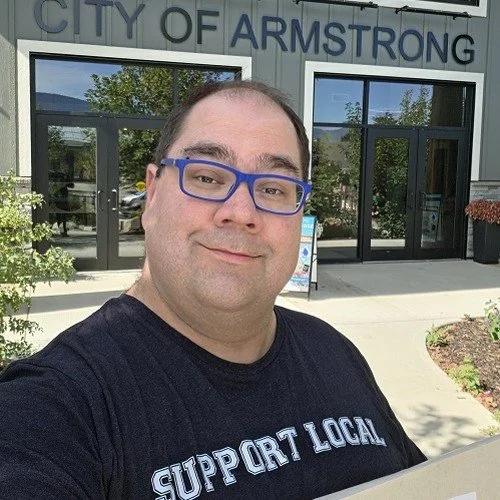
2026 Election Candidate
Environmental
Policies in the Armstrong Official Community Plan "direct future growth strategically to protect ecological and agricultural areas, offer more housing and transportation choices, support economic prosperity and diversity, prioritize sustainable municipal infrastructure planning, enhance community wellbeing, and support our transition to a more sustainable and climate resilient community." Please give local examples of 'good' and 'not good' building development in Armstrong, and state why. Do you support the downtown revitalization plan for Armstrong and why/why not?
Good development in Armstrong adds homes without changing what people moved here for. Suites and carriage houses on existing lots are my best example. They let seniors downsize or give young adults a more affordable option for a first home when they move out.
The Poole Street proposal is an example of a project that has brought a lot of apprehension from residents. It's an 80-unit, four-storey building right next to the wastewater treatment plant's settling ponds, and many neighbours are strongly opposed. I support non-market rental, because it's a housing tool that works for affordability, but it has to be in the right place. Most of Armstrong's open land is in the ALR, which we can't pull out of, so Poole Street may be one of the only sites available. If the community doesn't want it there, that leaves very few options, and I don't have an easy answer for that yet.
On the downtown plan (CARI), phase one is complete and I won't push to redo it unless there is a safety concern. There's no budget for that, and our businesses can't take another round of disrupted access. If later phases come back during my term, I'll push for more resident input before anything is designed.
Armstrong has experienced significant climate impacts for the last few years. How do you propose to address these crises, both in preparing ahead for disasters like drought, wildfires, heat domes and floods, as well as reducing greenhouse gas (GHG) emissions that lead to climate change?
Water is a big priority for me after seeing the challenges our neighbours in Vernon and Coldstream are having. Our supply and delivery need to be closely assessed, and growth has to be matched to what our fire, water and ambulance services can handle, so new homes don't stretch them thinner. If things keep getting drier, does it make sense to put more demand on a dwindling supply?
On emissions, I want every change the City makes to make sense for a city our size. I'll support changes that pay for themselves over time through lower fuel, energy or maintenance costs, and question the ones that don't. Our residents are already stretched on taxes but every little bit helps.
For wildfire, heat and flooding, I want residents to know the City's emergency plans well before they need them
Do you support the use of public funds to contribute to acquiring natural lands for environmental conservation purposes? Under what conditions would the perceived need for more housing, businesses, roads and other infrastructure prompt you to trade away natural lands with high ecological value for urban expansion?
Yes, when it's done in partnership. Armstrong's budget is small, and every dollar has to be weighed against the road, water and sewer work that needs to get done. Where the Regional District, the province or a land trust is leading and the City can add a share, I'd look at it seriously.
In Armstrong, I have come to understand that much of the remaining green land here is either in the Agricultural Land Reserve or isn't suitable for development. That means most of our growth will go up, not out. The new OCP includes mapping of wildlife corridors, and I'd use it when development comes forward. If a project ever proposed building on high-value natural land, I'd only support it if there was no reasonable alternative. I'd rather see infill on land that's already developed, with growth paying its own way through development cost charges.
Drought, contamination, increasing demand are just some of the water issues. What actions would you prioritise to protect our creeks, lakes, aquifers, and groundwater for home and agricultural water sources, habitat for fish and wildlife, and human recreation?
Protecting our water starts with investing in and maintaining our water infrastructure.
A filtration system has been one of the options for Armstrong, but it's very expensive, and that cost would land directly on our taxes. I've heard time and time again from residents that they're taxed to the max, so we can't spend money frivolously. Staff have recently presented options for our water supply infrastructure, and they need very serious consideration. I want the solution that protects our water for the long term at a cost Armstrong can carry.
Water doesn't stop at the city limits. We share it with Spallumcheen and the farms around us, so council should work closely with the Township, the Regional District and the province on the creeks and aquifers we all depend on.
Social
In smaller communities we need to be creative in how we help one another; how do you see the role of local government in this?
Armstrong already has some good tools for this. The City gives permissive tax exemptions to a lot of local organizations. It isn't a cash grant, but it has the same net effect, and I think it's a great way to support the groups doing the work.
Local businesses and organizations put on events like Light Up, the Harvest Pumpkin Festival, Canada Day and the Twilight Markets. I've volunteered with many of them, and I've seen how much of this town runs on a small group of volunteers. I don't think local government should try to take that over. It should make their jobs easier.
Over the years, I've watched the applications for things like road closures get more complex. I'd like to see that process simplified, so our businesses and organizations can keep holding these events. They bring money directly into our businesses, and they're a big part of the arts and culture in our town.
How do we tackle misinformation and growing distrust in local government as well as uncivil behaviour on social media and in person?
A lot of the distrust I hear comes from people finding out about a project after it's already decided. On CARI and the downtown bollards, the City followed protocol, but the notices didn't reach most people. When residents feel blindsided, rumours fill the gap.
Fixing that is a big part of my campaign. I'd push for communication to be planned into each project from the start, with more open houses, an easier-to-use City website and plain-language or visual summaries of big documents like the OCP. The City already has a communications person and a communication policy. The policy clearly didn't work for CARI, and the fix may be as simple as updating it so the City shares information earlier and more proactively. That mostly means changing the process, and it doesn't need new spending.
On civility, I'll hold myself to the standard I'm asking for, online and in person, and I'll treat people who disagree with me with respect.
What personal and/or professional experience has most shaped your understanding of Truth and Reconciliation, and how would it influence your decisions as a municipal elected official?
My first exposure to First Nations culture was as a kid at the Calgary Stampede, where I grew up. Watching the hoop dancing and hearing the drumming in person stuck with me after all these years.
Since then, I've had the honour of filming ceremonies around our region, including the salmon run with the Adams Lake Indian Band, drumming with the Splatsin and a piece with the Okanagan Indian Band focused on preserving their language. I'm really encouraged to see these cultures on full display, because residential schools and other policies were built to erase those languages and ceremonies. The more they're shared, the more resilient those cultures become, and I love to see that.
Armstrong sits on the unceded territory of the Syilx (Okanagan) Peoples and the Splatsin of the Secwépemc Nation. Our new OCP commits the City to building relationships with them and to educational resources for staff, Mayor and Council. If I'm elected, I'll uphold that commitment and make use of those resources.
Cultural
How do you personally engage with arts, culture and heritage in Armstrong, and how do you think local government should support these features of our community?
Most of my involvement with arts and culture in Armstrong is behind a camera. I film the Legion's Remembrance Day and candle ceremonies, and I've sat on the planning committees for Light Up, the Harvest Pumpkin Festival, the Big Cheese Festival, Canada Day, Multicultural Days and the downtown markets. I've also been fortunate to film many local artists and share their craft, whether it's painting, music or something else.
A lot of the events in Armstrong include local artists, and they've become great platforms for those artists to share their work and our local culture. The easier local government makes these events to run, the better it is for our community.
On heritage, the OCP commits to protecting the downtown's character as buildings are renovated. I support that, and I'd want property owners to get clear guidance before they start, so heritage doesn't feel like a barrier.
Economic
What is your understanding of how small local governments can support our economic development, including the success of our small local businesses?
The best thing council can do is make the City easier to work with and make sure business owners are heard.
That's one of the two main reasons I'm running. Business owners in Armstrong asked me to put my name forward because they feel unheard by the City and don't have time to run themselves. I own Rhythm Productions, so I know what a week of lost access or an unclear permit costs a small operation.
If I'm elected, I'll hold regular sit-downs, monthly or quarterly, starting before the end of 2026, where businesses can bring concerns to me for council. I've also committed to a face-to-face conversation with every brick-and-mortar business in Armstrong by the end of my first year.
From there, council's job is to remove the barriers that don't need to be there, without cutting corners on safety.
What is one action the municipality should take to strengthen our local food system and improve access to healthy, affordable food? Why that action?
The one action I'd push for is making it easy for local farms and producers to sell directly in town.
Armstrong is surrounded by farmland, and we even have farmers producing food right inside the city. Some of the best food in the valley is grown only a few minutes from our Fair Grounds, and the shortest path from those farms to local families is a local market. The OCP already commits to supporting the Armstrong Farmers Market and Winter Market, and I've helped plan the Twilight Markets through the Chamber.
The City can help by keeping vendor permits and fees simple and affordable, making good space available and promoting the markets as part of downtown revitalization. That supports our farmers and small businesses, and it brings more people downtown.
Health
As Mayor / Councilor, how would you work to support access to medical services?
While the Province and Interior Health has control over healthcare infrastructure, what council can do is support local efforts to bring doctors here.
A lot of residents in Armstrong can't find a family doctor. The Haugen Health Society has been proposed specifically to bring doctors to Armstrong and area residents, and I support it. A locally funded mechanism right here in town is something I can get behind.
How will you ensure that our planning of our built environment, our programs and our policies support the diverse physical and mental health needs of our population?
Our population is getting older, and a lot of Armstrong wasn't built with walkers or wheelchairs in mind. The OCP calls for updating the City's Age-Friendly Plan, and we already have an Active Transportation Plan. I'd want both to show up in everyday decisions like curb cuts and snow clearing on the routes people actually walk.
For mental health, one of the best things a small town has is the events that get people out of the house. Light Up, the markets and the Legion ceremonies are where people check in on each other. Keeping those easy to run is a health decision as much as an economic one.
People also can't use services they don't know about. Clear, early communication from the City is a big part of making sure what we have reaches the people who need it.
