
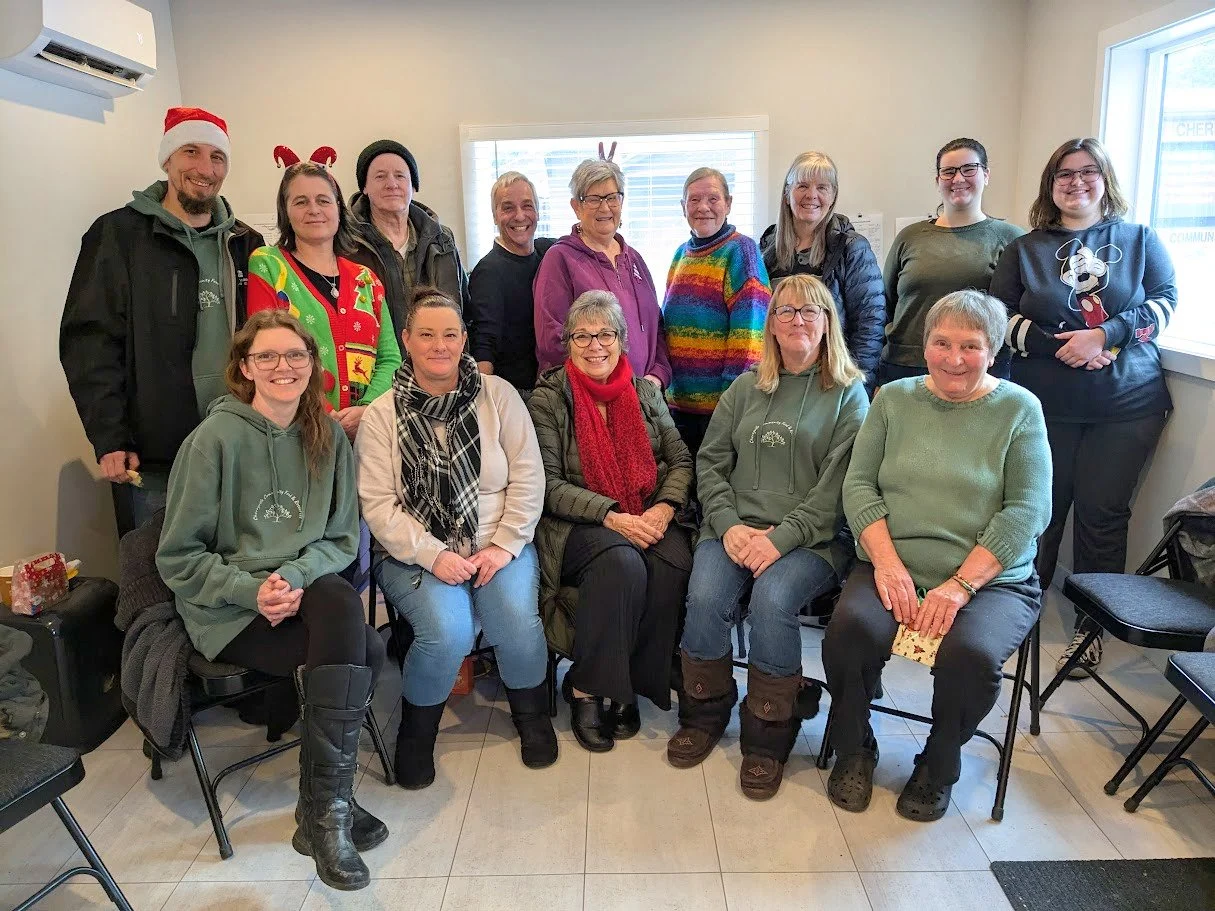
Cherryville Community Food & Resource Society shows what’s possible when rural communities are trusted to design their own solutions.
When Sharon Harvey took over Cherryville’s annual Christmas Hamper program in 2008, about 20 hampers went out that year. What she noticed, though, was that families in Cherryville were driving 30 kilometres to Lumby every month for food hampers, because there was nowhere closer to go.
She decided she could fill that gap herself.
It started with three or four hampers a month. By 2010, she had registered the Cherryville Food Bank as a non-profit. By 2017, demand had grown enough that the community needed a proper warehouse — a build made possible through a lead grant from the Community Foundation North Okanagan (CFNO). Today, the organization now known as Cherryville Community Food & Resource Society (CCFRS) distributes 40 to 42 hampers a month, with 90 hampers given out this past Christmas. “We have yet to plateau,” says Meghan Derkach, Sharon’s daughter and the Executive Director of CCFRS.
The numbers clearly demonstrate that. In 2025, CCFRS distributed 479 food hampers (a 10% increase from 2024) to 90 different households representing 212 unique individuals. Seventy-two of those individuals were children. The food bank received just over 40,000 pounds of food donations over the year.
Meghan grew up volunteering alongside her mother. Her own passion took root somewhere different: at a community luncheon as a young person, she listened to a group of older adults talk about having to leave Cherryville because there were no supports to help them age in place.
“It broke my heart,” she says. “I wanted to change that.”
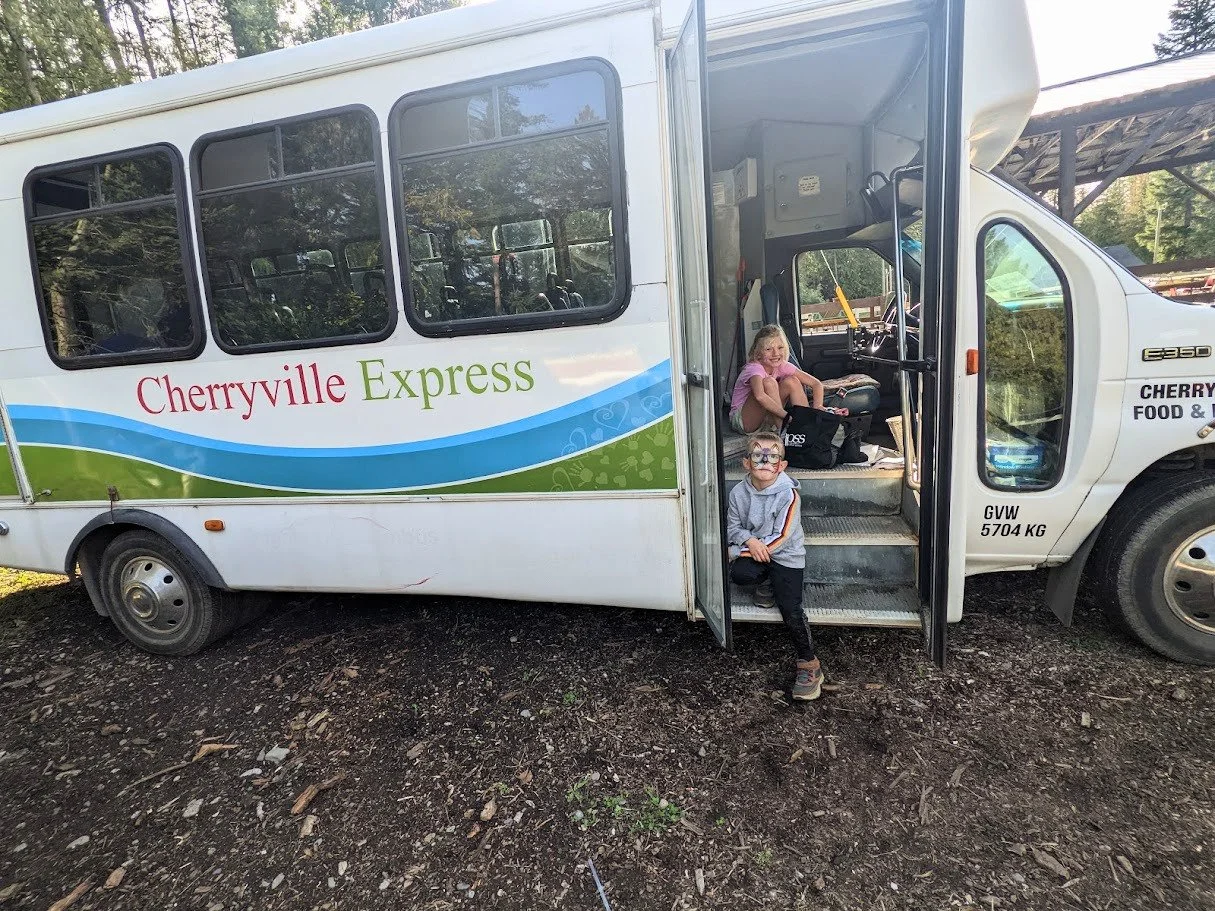
When COVID hit in 2020, isolation among Cherryville’s older adults was immediate and severe. CCFRS launched a drive-thru meal program and friendly visit calls to check in on aging neighbours. The model worked, and grants followed. Youth programming was added after a community needs survey identified a gap. In 2021, the food bank changed its name to reflect their broader mission: serving the whole community, beyond food security alone.
In January 2023, CCFRS opened a new Resource Centre alongside its food bank warehouse. This is a physical hub where residents could access support across five interconnected areas: financial, practical, mental, physical, and social. In 2025, the Resource Centre served 82 clients, that’s a 63% increase from the year before, with clients ranging in age from 19 to 100. Across all its programs combined, CCFRS supported roughly 456 unique individuals last year.
Cherryville is what Meghan calls a “service-area desert.” Most specialized supports, like income assistance, mental health services, and healthcare, are 30 to 60 kilometres away. For low-income households, older adults who no longer drive, or residents managing compounding stressors, that distance can be the difference between getting help and going without.
“For some folks, CCFRS is a lifeline,” Meghan says. “Being central, staffed with locals who are familiar faces and have lived experience, dismantles the stigma for folks to reach out for help.”
She describes food security as the entry point to broader wellbeing: a basic need that, once met, opens the door to support in other areas of life. Many of the people who come in for a hamper end up navigating much more, a disability application, a housing crisis, a difficult medical diagnosis, or simply the need for human connection.
“Coming to CCFRS first is a much smaller, more manageable step,” Meghan says. “From there, we just lock arms and take those bigger steps together.”
CCFRS now connects clients to 9 Cherryville-based organizations and 20 outside agencies, including BC Housing, Interior Health, FNHA, the Cancer Clinic, palliative care, and Work BC.
The organization’s tagline, Families Helping Families, has held steady from the very beginning. It started with the Harvey family: Sharon, her husband Morgan, and their children. It has grown into something much larger, but the spirit has held.
Meghan now serves on the Grant Review Committee for the Community Foundation North Okanagan (CFNO), helping to evaluate applications from charities across the region. CCFRS itself was a 2024-2025 recipient of CFNO’s Smart & Caring Community Grants, part of a record-setting $467,000 distributed to 50 local organizations during CFNO’s 50th anniversary year.
“Cherryville is showing us what becomes possible when local people are trusted, resourced, and given the space to lead,” says Lisa Deargle, Communications Director of CFNO. “Meghan and her team have built a model other rural communities can learn from.”
Meghan’s hope for Cherryville is twofold. Practically, she would love to see supportive housing built locally and a clinic where residents could access healthcare without driving into Vernon. But the larger hope is bigger than Cherryville itself.
“That our story can be both an inspiration to other rural and remote communities, but also a blueprint on how to get started,” she says. Building local capacity, she points out, has reciprocal benefits for the whole region: fewer hospital admissions, shorter stays, people living at home longer, less pressure on long-term care.
It’s a vision rooted in equity, that geography shouldn’t determine the quality of support a person can access. For now, CCFRS continues to grow alongside the community it serves, one hamper, one conversation, one neighbour at a time.
Learn more about CCFRS at cherryvillefoodandresources.ca, and about CFNO’s Smart & Caring Community Grants at cfno.org/smart-caring-community-grants.
This story was feature in local media:
https://vernonmorningstar.com/sponsored-content/families-helping-families-how-a-cherryville-food-bank-grew-into-a-lifeline-for-an-entire-community
